
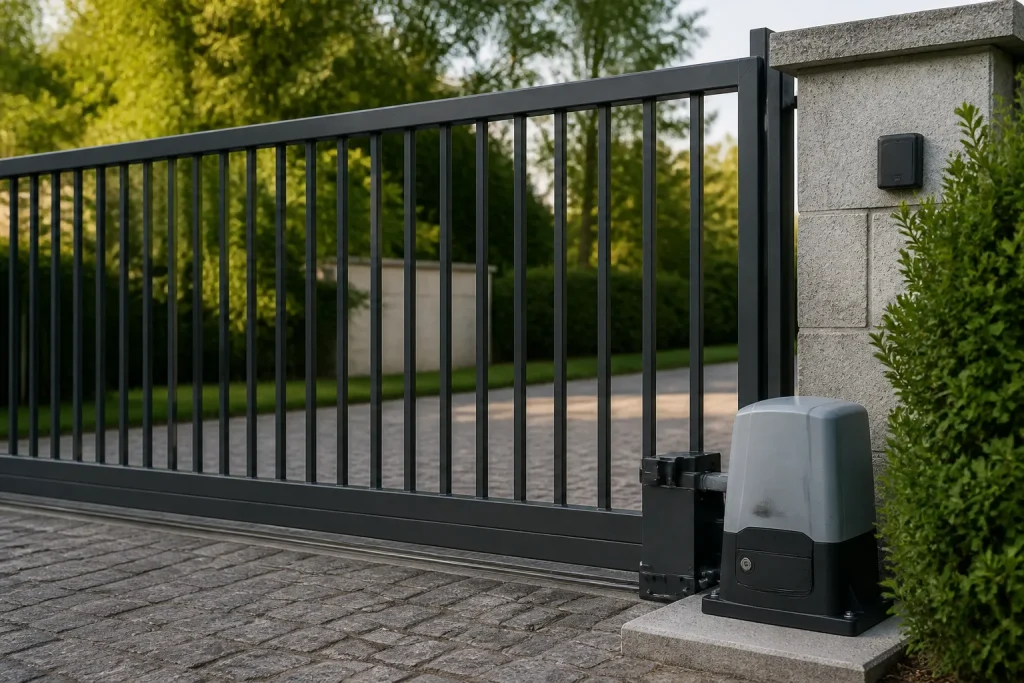
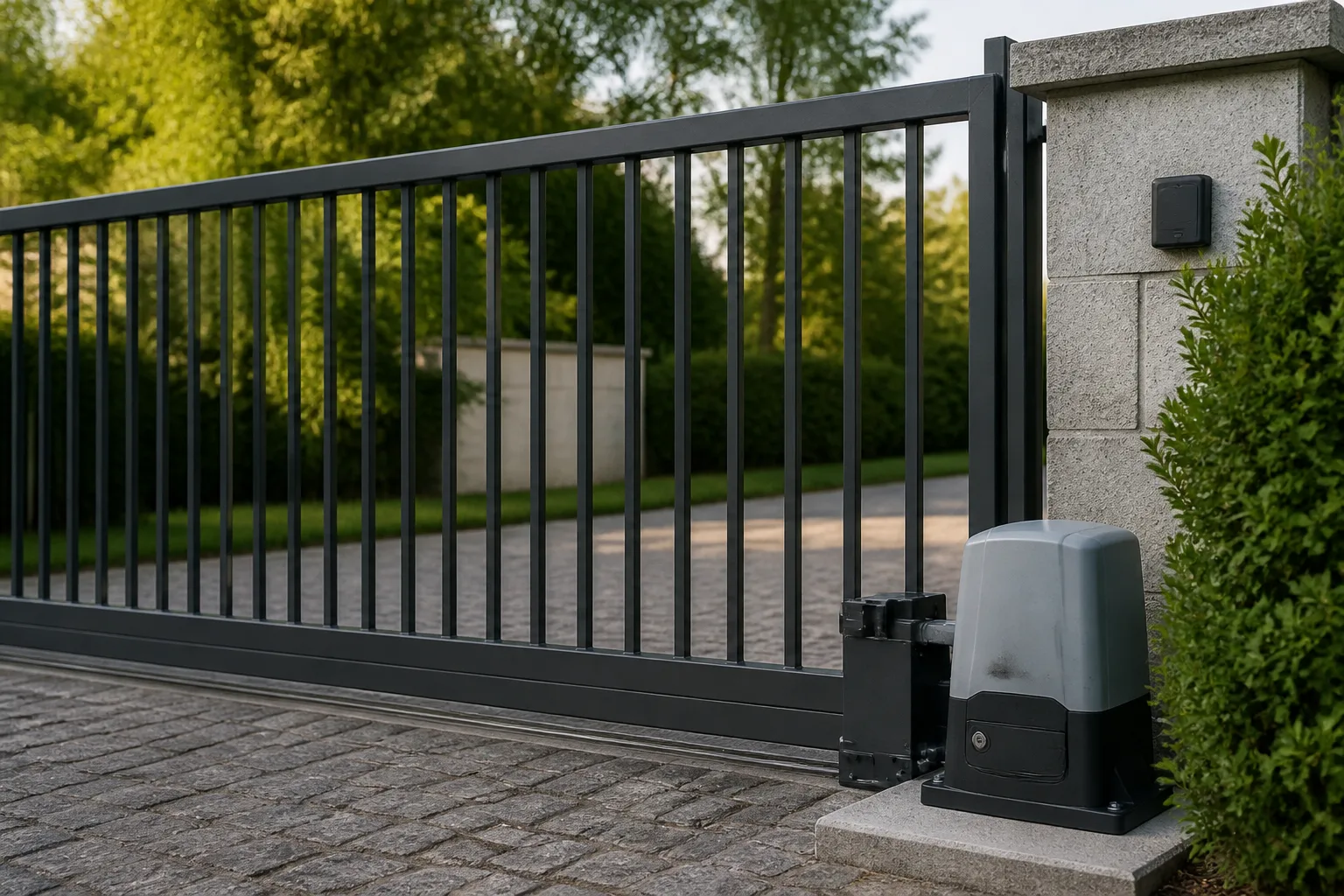
FAAC Gate Repair in Rochester: A Homeowner’s Guide
FAAC operators don’t fail the way a LiftMaster or a Mighty Mule fails. A FAAC swing gate usually runs on a hydraulic ram filled with fluid, and that fluid is the reason the gate is whisper-quiet in July and the reason it refuses to move on a Rochester morning in January. Most homeowners assume the motor is dead and start pricing a replacement. It’s rarely the motor. In our experience, cold-thickened hydraulic fluid and the error codes it triggers are behind a large share of the FAAC service calls we get in Rochester. Here’s what’s actually happening and what a proper repair looks like.
Why FAAC’s Hydraulic System Fails Differently
FAAC builds hydraulic operators, which is not the same design as the electromechanical gear-driven arms used on many popular residential openers. Hydraulic means a pump pushes fluid through a circuit to extend and retract the arm. There are no gear teeth to strip, no grease to pack, and very little mechanical noise. That quiet operation is a real benefit, right up until the temperature drops.
Hydraulic fluid thickens as it gets cold. On a mild day it flows easily and the operator cycles smoothly. On a hard freeze in Rochester, that same fluid resists the pump, and the pressure to move the gate climbs. The control board reads the strain and does what it’s supposed to do: it stops the cycle to protect the motor. To the homeowner, the gate simply won’t open. The arm doesn’t move, the board throws a code, and it looks exactly like motor failure.
What follows is a new operator when a fluid and seal service was the actual answer. If your FAAC gate is sluggish or stalling in cold weather and fine when it warms up, that pattern points to hydraulics almost every time. It’s also why we treat electric gate repair as its own discipline rather than a side job. A technician who doesn’t recognize the cold-weather behavior will chase the wrong part.
Decoding the Most Common FAAC Error Codes
FAAC boards report faults in a shorthand that’s easy to misread. Three come up again and again on Rochester service calls:
- E1 usually points to a problem in the safety or obstacle circuit – a photocell that’s dirty, misaligned, wet, or blocked. Before you blame the board, look at the photo eyes.
- E2 generally relates to the encoder or the position feedback from the arm. If the board can’t tell where the gate is, it won’t trust the arm to move. Cold, stiff hydraulics can trigger this because the arm moves more slowly than the board expects.
- Obstacle detection faults show up when the gate meets resistance it reads as a blockage. On a cold Rochester morning, thick fluid is resistance. So is a gate whose hinges have stiffened up.
The trap is that all three can look identical from the outside: the gate stops and won’t run. A proper diagnosis checks fluid condition, hinge drag, photocell alignment, and board feedback in sequence. Guessing at one code without checking the others is how a repair turns into three visits.
Not All FAAC Operators Repair the Same Way
FAAC makes several operator families, and the repair procedures are not interchangeable. Knowing which one you have changes everything about the fix.
The 400-series swing operators are the workhorse arms you see on a lot of driveway gates. Repair centers on the hydraulic ram, seals, and fluid, plus the control board and limit settings. The 500-series covers a different range of gate weights and sizes, and while the hydraulic principle is shared, the internals and service steps differ. B-CBA underground operators sit concealed under the gate leaf, which changes access, drainage, and how you get at the mechanics at all. An underground unit in a Rochester freeze-thaw cycle deals with water and ground movement in ways a surface arm never does.
This is why a generic approach fails. A technician who’s only worked on surface-mounted arms will be guessing on an underground unit, and vice versa. When someone quotes you a fix, it’s fair to ask which operator you have and what the specific service steps are for that family. If the answer is vague, that’s your answer.
What “Authorized FAAC Service” Actually Means
“Authorized” gets used loosely in this trade, and homeowners should know what to verify. What matters is whether the technician can demonstrate real familiarity with the FAAC platform: the specific operator family you own, its board, its hydraulics, and its error logic. A few questions cut through it fast:
- Which FAAC operator families do you service, and have you worked on mine before?
- Do you diagnose hydraulics and board faults, or do you send those out?
- Will you confirm fluid condition and hinge drag before recommending a new operator?
- If a board needs replacing, do you use OEM parts?
A company that can answer these specifically knows the platform. One that hedges is likely to hand you a workaround. We’re independent and experienced with FAAC – not a factory dealer – and we’d rather tell you that plainly so you can judge the work on its merits.
Repairs That Quietly Void Your FAAC Warranty
Some shortcuts look harmless and aren’t. On a FAAC system, three stand out:
- Improper fluid substitution. Topping off or refilling a hydraulic ram with the wrong fluid, or a generic substitute, changes how the pump behaves. It can damage seals and skew the cold-weather performance the system depends on.
- Non-OEM control boards. Aftermarket boards may not match the FAAC error logic, safety behavior, or encoder feedback. You trade a cheaper part for a system that misbehaves in new ways.
- Incorrect limit switch adjustment. Limits tell the arm where the gate starts and stops. Set them wrong and the operator fights itself, strains the hydraulics, and shortens the life of the parts you just paid for.
If a repair is under warranty, the safest path is a technician who uses OEM parts and follows the correct service steps. A quick workaround that “gets it running” can cost you the warranty and the repair.
When to Call a Pro
FAAC hydraulics, control boards, and limit settings are not a cautious homeowner’s project, and we’ll say so directly. Working on a powered operator means stored energy, moving arms, and mains wiring. Board-level work and safety-circuit diagnosis belong with someone trained on the platform. A gate that stops mid-cycle, throws a code, or won’t reverse on an obstacle is a safety issue, not just an access problem. If you’re weighing a repair against a new install, we’ll tell you honestly which one makes sense for your gate. Our technicians have up to 10 years of experience, and a fair share of it has been spent on exactly this platform.
Related services in Rochester: if you’re not sure what’s wrong yet, start with gate repair, and for the full picture of how we work, see Rochester Gate Repair. If you’re exploring the broader area, our Rochester page covers what we handle locally.
The Bottom Line
FAAC operators are overbuilt and worth fixing, but they need a technician who knows the platform. Most winter failures trace back to cold-thickened hydraulic fluid and the codes it sets, not a dead motor. Know your operator family – 400-series, 500-series, or B-CBA underground – and ask the questions above before you hire. Stick to OEM parts and correct fluid, and don’t let a shortcut void the warranty. We work on nine major brands, from Mighty Mule and Ghost Controls openers to DoorKing and Elite commercial systems, so we can also tell you where your FAAC fits against other options. If you’re in Rochester and need help, Rochester Gate Repair offers free estimates – call (866) 942-8010. We answer 24/7. Fast dispatch from 7am to 7pm, Sunday through Friday.
Frequently Asked Questions
Usually yes, by watching the weather. If the gate is sluggish or stalls when it’s cold and runs better when it warms up, that pattern points to hydraulic fluid thickening rather than a failed motor. If it’s dead in warm weather too, check the error code and the safety circuit first.
Look for the model label on the operator arm or underground housing – it tells you the family, such as 400-series, 500-series, or B-CBA. That tells a technician exactly which service steps apply. Call (866) 942-8010 and we can help you identify it.
Cold weather is just harder on hydraulics; it doesn’t void anything. The key is that the repair uses the correct fluid and OEM parts, because the wrong fluid makes cold-weather performance worse and can damage seals. Proper service restores the cold-weather behavior.
A good gate leaf with a serviceable FAAC operator is often worth repairing, especially if the fix is fluid, seals, or a board. Replacement makes sense when the operator is beyond service or the gate itself is failing. Call (866) 942-8010 for a free estimate and we’ll tell you which path fits your gate.
Written by the team at Rochester Gate Repair.
Need Gate Repair Help?
Call Rochester Gate Repair - licensed & insured, here with fast help in Rochester.
(866) 942-8010